
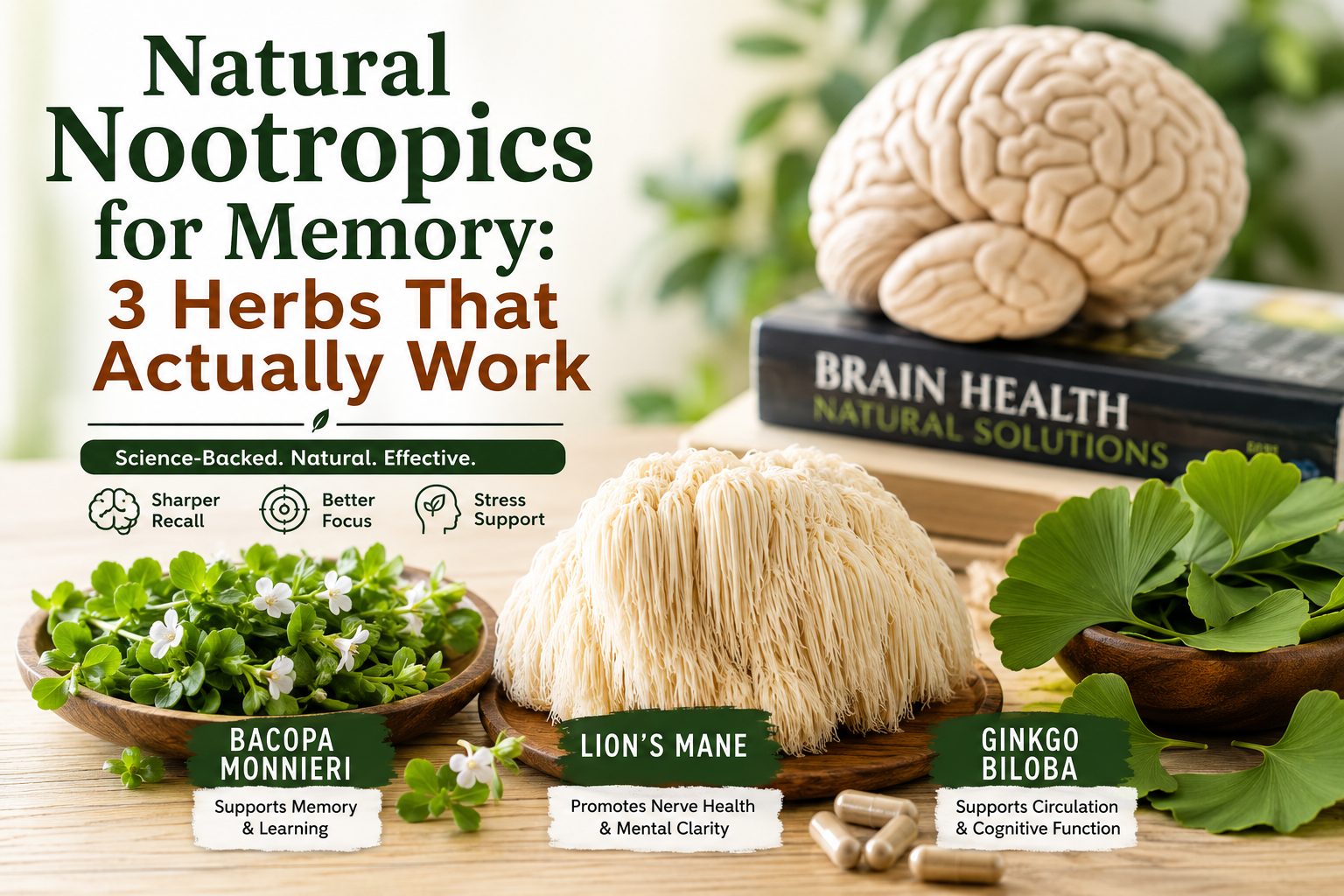
Last week I forgot my own postal code. I typed it in a form, stared at it, and had to rummage through an old envelope to see whether I was making stuff up. What happened was trivial. But I should mention that this is not the first time this happened. If you’re reading this, chances are you’re facing similar problems. Going into a room and forgetting what you were going to do there. Not remembering a coworker’s name despite the fact that you have just exchanged greetings.
It is not a matter of a broken brain. That brain, in fact, is just tired, starving, or switched to autopilot mode. Natural nootropics for memory aren’t going to change a situation when you haven’t slept well, but some types of nootropic substances might become helpful if consumed consistently.
What constitutes nootropics?
Nootropic is, by definition, something that helps the brain function well. Memory, concentration, and vigor. There are also synthetic nootropic substances, and this text focuses on natural nootropic substances, which have been being used long before science has discovered them.
A few improve blood flow so your brain gets more oxygen. Others work more directly on the chemicals your brain uses to store and retrieve memories.
You don’t need a science degree here. Knowing which claims have some substance behind them is essential while identifying which claims are merely names.
Bacopa Monnieri
This is an ancient remedy of Ayurveda, but what is interesting about this one is that modern science generally confirms its effectiveness. It seems to help the brain both form new memories and hang onto them longer. A handful of studies show better recall and faster reaction time, and some people report feeling a bit less anxious too, though that finding is less consistent.
Small print worth knowing: the National Center for Complementary and Integrative Health points out that most of these trials are small, so don’t treat any single study as gospel.
Also, bacopa is slow. Painfully slow if you’re impatient. Eight to twelve weeks before you’ll notice anything, which rules it out if you’re the type who gives up on supplements after five days.
This is one of the more reliable memory-boosting herbs, and it’s a big reason it shows up in natural nootropic blends from HerbalStackPro.
Lion’s Mane and Why It’s Suddenly Everywhere
I’m sure you have seen Lion’s Mane mushroom on the menu of a cafe by now; it is that common. It is an untidy white mushroom found in dead hardwood trees, which doesn’t look like anything edible at all, quite frankly. But what makes it interesting enough for some research?
Early studies indicate that it could help in the production of nerve growth factor, which is required by the brain to develop neurons.
A small trial published through the National Library of Medicine found older adults scored better on cognitive tests after several weeks on it. Small group, though. Small studies don’t always survive being repeated at a bigger scale, and that’s just something to keep in the back of your mind.
Are the lion’s mane memory benefits proven beyond doubt? No. Is there enough smoke to suggest a fire? Probably.
Ginkgo Works Differently
Ginkgo biloba is an old topic in this discussion. Unlike bacopa and lion’s mane, ginkgo biloba does not affect brain chemistry; it focuses on improving blood flow, which helps bring more oxygen to your brain cells.
Results are mixed. Some studies show real improvement in working memory, mostly in older adults. Other studies show basically nothing. That used to bother me until I realized this is just how herbal research goes most of the time; small effect sizes get pushed around by study design and who’s in the room. It doesn’t mean ginkgo is useless. It means don’t expect a dramatic before-and-after.
Pair it with decent sleep and it’s worth trying. Skip the sleep part, and no amount of ginkgo saves you.
Picking a Product That Isn’t a Waste of Money
Search for human-based trials and not merely animal trials. Search for a product that has a specific mg amount listed on the bottle and not “proprietary blend.” This usually means there’s too little of the ingredient to actually make an impact. Find a company that performs independent tests because those that don’t probably have their reasons.
If the label claims “clinically proven” but cannot be found online, pass on it.
The best nootropics for memory and focus check all three boxes. Most products on the shelf check maybe one.
Focus Comes First, Memory Follows
Here’s something people miss: you can’t remember what you never paid attention to in the first place. That’s the whole reason nootropics for concentration end up helping memory too, almost by accident.
L-theanine and a little bit of caffeine form the traditional blend. Caffeine makes you more alert, while L-theanine makes you more relaxed so that you are not anxious. Rhodiola rosea is another supplement, which is different since it blocks the stress response so that your mind can concentrate.
Don’t Waste the Money You Just Spent
Buying the bottle is easy. Actually learning something from it takes more discipline than most people expect.
One herb at a time. That’s it, that’s the rule. Stack five new things at once, and if something changes, you’ll have no clue what caused it. Give whatever you pick several real weeks before writing it off, because herbal compounds build up slowly. They’re not a shot of espresso.
Sleep and stress matter more than any bottle will. I know that’s not what a supplement blog is supposed to say, but it’s true, and pretending otherwise doesn’t help you.
Taking medication? Talk to your doctor first. “Natural” doesn’t automatically mean harmless, no matter what the label implies.
Where This Leaves You
Your memory responds to sleep, stress, food, and yes, to what you take to support it. Bacopa, lion’s mane, and ginkgo each bring something different, and which one actually helps you depends more on your own body than anything written here.
If you want a formula built on ingredients that have real research behind them, check out HerbalStackPro’s nootropic collection and pick one herb to try properly. Give it a real four weeks. Then decide.
FAQ
Do natural nootropics for memory actually work?
Some do. Bacopa and ginkgo have real human studies behind them. Results still vary person to person, and nothing here works overnight.
How long until I notice a difference?
Eight to twelve weeks, generally. If you want the results quickly, it will be annoying; otherwise, it’s a good effect.
Is it safe to take these every day?
Usually, at normal doses. They can still interact with medication, though, so check with a doctor first if you’re on any prescriptions.
Is it possible to combine these 3 herbs, bacopa, lion’s mane and ginkgo?
While it is possible, a better approach would be to take one herb first rather than all three together for it would be impossible to know which of them has any impact on the body.
What is the difference between memory enhancing and attention improving nootropics?
What’s the difference between memory nootropics and focus nootropics?
Memory herbs help you store and pull up information. Focus herbs help you pay attention right now. They overlap a lot in practice, since you can’t remember what you never noticed to begin with.