
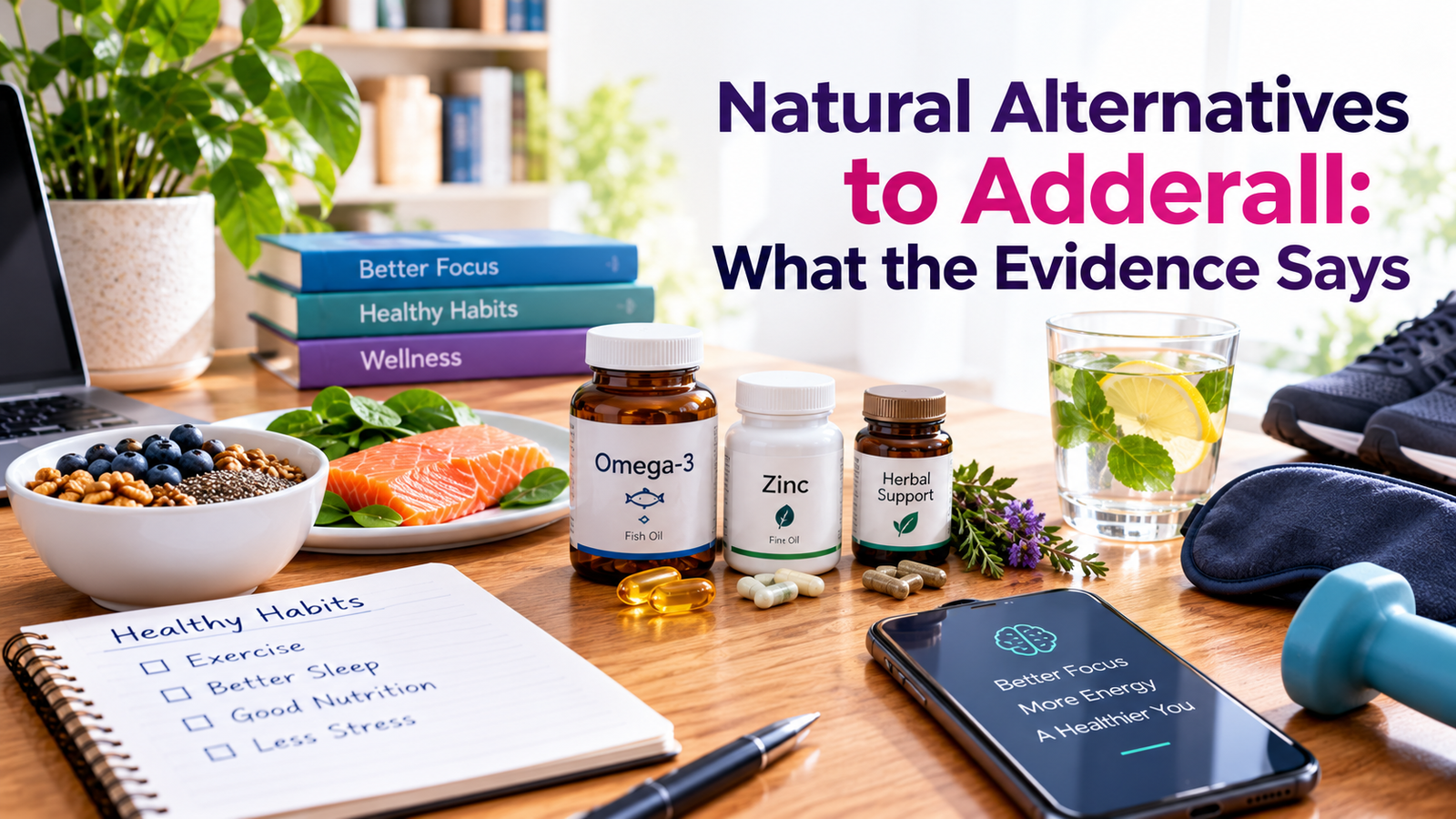
Two in the afternoon. You’ve read the same email four times. A friend texts, “Try this herb; it’s basically Adderall.” You open a tab and start digging.
Fair enough. Some people hate the side effects. Some can’t get a prescription. Some just want something gentler. But here’s the problem: the web is packed with hype and short on proof. So let’s look at natural alternatives to Adderall the boring way, using what NIH researchers found.
First, one rule. If a doctor prescribed you something, don’t stop or change it on your own. Call them.
Why people want natural alternatives to Adderall
The reasons differ a lot, and I get each one. A few people dislike how a stimulant feels. Others worry about side effects. And some don’t have ADHD at all. They’re tired, scattered, and want a sharper brain at work.
Those are three different situations. The first two need a doctor in the loop. The third usually starts with sleep and movement, not a powder.
What natural alternatives to Adderall can and can’t do
Here’s the headline. The National Center for Complementary and Integrative Health is part of the NIH. It says no complementary approach studied has been conclusively shown to beat standard ADHD treatment. That’s from its guide to complementary health approaches for ADHD.
Does that mean nothing helps? No. It means nothing has been shown to replace treatment. Keep that in mind next time a bottle promises “natural focus.”
One more catch. Much of this research was done on kids and teens. What works for adults is less clear, and I’ll point that out as we go.
Natural alternatives to Adderall with some support
Let’s start with what actually has something behind it.
Exercise. According to NIH’s science overview on ADHD, there is evidence of small to moderate improvements in core symptoms from short-term aerobic exercise like yoga. Small to moderate effects. Not a miracle, but it is free and makes you feel good and helps you sleep. A walk will do.
Sleep. Poor quality of sleep negatively affects concentration. This is my own personal recommendation and is not backed up by any specific evidence. However, the NIH claims that melatonin might help people with ADHD sleep better at night. Its short-term use is safe; there is little information about its long-term effects.
Zinc, sometimes. The summary says zinc may help a little for some kids with ADHD, mostly those who are low in it. Too much can be toxic, so don’t guess. Ask about testing.
Supplements with weak evidence
This is the crowded shelf of natural alternatives to Adderall. Here’s what the NIH reports.
Omega-3 fatty acids come up constantly. The proof is shaky. A 2023 review found weak signs of a medium-term benefit. It also found strong evidence of no effect on total parent-rated symptoms. Where omega-3 helped, it looked weaker than stimulant medicine. Side effects are mostly mild, such as stomach problems.
In one study, Ginkgo biloba was less effective than methylphenidate, and it is unknown whether it is more effective than a placebo. It may also raise bleeding risk.
Ginseng, valerian, bacopa, passion flower, and pine bark (Pycnogenol) have been studied in only very few and limited studies. The National Institutes of Health states that there is no evidence available for Pycnogenol.
See the pattern? Lots of names. Not much proof.
Be careful with these.
In case of ADHD in children, St. John’s wort was just as ineffective as placebo. Moreover, the herb interferes with many medications. In case you are taking any antidepressants, birth control pills, or other medications, consult your pharmacist first.
Caffeine is a mixed bag. The NIH summary says high doses may give a small lift, though that’s controversial in kids, and lower doses showed no benefit over placebo. More coffee can also wreck your sleep, which then wrecks your focus. Funny how that works.
Then there’s DMAA. The NIH reports no proof that it works and serious heart-related safety worries, plus an FDA warning. If a label lists it, put the bottle back.
Here’s a bigger point about natural alternatives to Adderall. Many of them have little safety data in people with ADHD. “Natural” doesn’t mean safe. Herbs are real chemicals, and they do things in your body.
Habits that cost nothing
None of these natural alternatives to Adderall are magic. Some are my own general tips, not NIH findings. They’re free, though, and they carry no risk of a bad drug mix.
Protect your sleep. Move every day. Break big jobs into tiny ones. Try short bursts of work with a timer, then a real break. Write things down instead of trusting your memory. Silence notifications for an hour. Stuck? A quiet walk often beats another coffee.
Other approaches have mixed results. The NIH says neurofeedback evidence is mixed, and meditation evidence is unclear, though studies hint at a small-to-moderate effect in young people. Maybe they’ll help you. Don’t count on it.
Talk to a professional.
Considering natural substitutes for Adderall? Do yourself a favor and make sure you really need a medical examination. If you’re having problems concentrating that affect your job performance, study, social life – see a physician. He will determine what exactly is the cause of the issue: it may be ADHD, lack of sleep, anxiety disorder, hypothyroidism, or something else entirely.
Currently taking Adderall and considering changing your medications? Consult with the prescriber. Withdrawal from stimulants may influence your mood, and your prescriber will be able to assist in switching the drugs safely. Make sure to bring to him a list of all substances used, including supplements. It’s what the NIH recommends doing before trying complementary treatments.
Your next step
Choose one habit from the list of natural Adderall alternatives to try this week. Take a walk every morning for twenty minutes. Or get your sleep schedule in order. Or write down your three most important things to do tomorrow night. Try it for a week and see how things change. And if a supplement is appealing, have a look at it with a pharmacist first.
For more on focus, see our guide to the best nootropic stack for focus, and browse the rest of our nootropic articles. Be skeptical of big promises, especially around natural alternatives to Adderall. The honest sources sound a lot like this one.
This post is general information, not medical advice. Talk with a doctor or pharmacist about your own health, and never stop prescribed medicine without their guidance.
FAQ
What are natural alternatives to Adderall?
Options include exercise, sleep patterns, and supplement types such as omega-3s, zinc, or herbs. No supplement has proven more effective than conventional ADHD treatment through clinical trials, so see your physician.
Is exercise beneficial for treating ADHD?
To an extent. NIH reviewers have observed small to moderate benefits of short aerobic exercise periods. Exercise is low-risk, and there might be additional benefits for sleep and mood.
Does omega-3 work for ADHD?
The evidence varies. According to a 2023 study, omega-3 does not affect certain symptoms, and its potential positive effects are lower than those of stimulant medications.
Are focus herbal supplements safe?
Not necessarily. St. John’s wort affects a lot of medications, while ginkgo may increase the chances of bleeding. There are serious warning labels on some of these supplements. See your pharmacist before buying them.