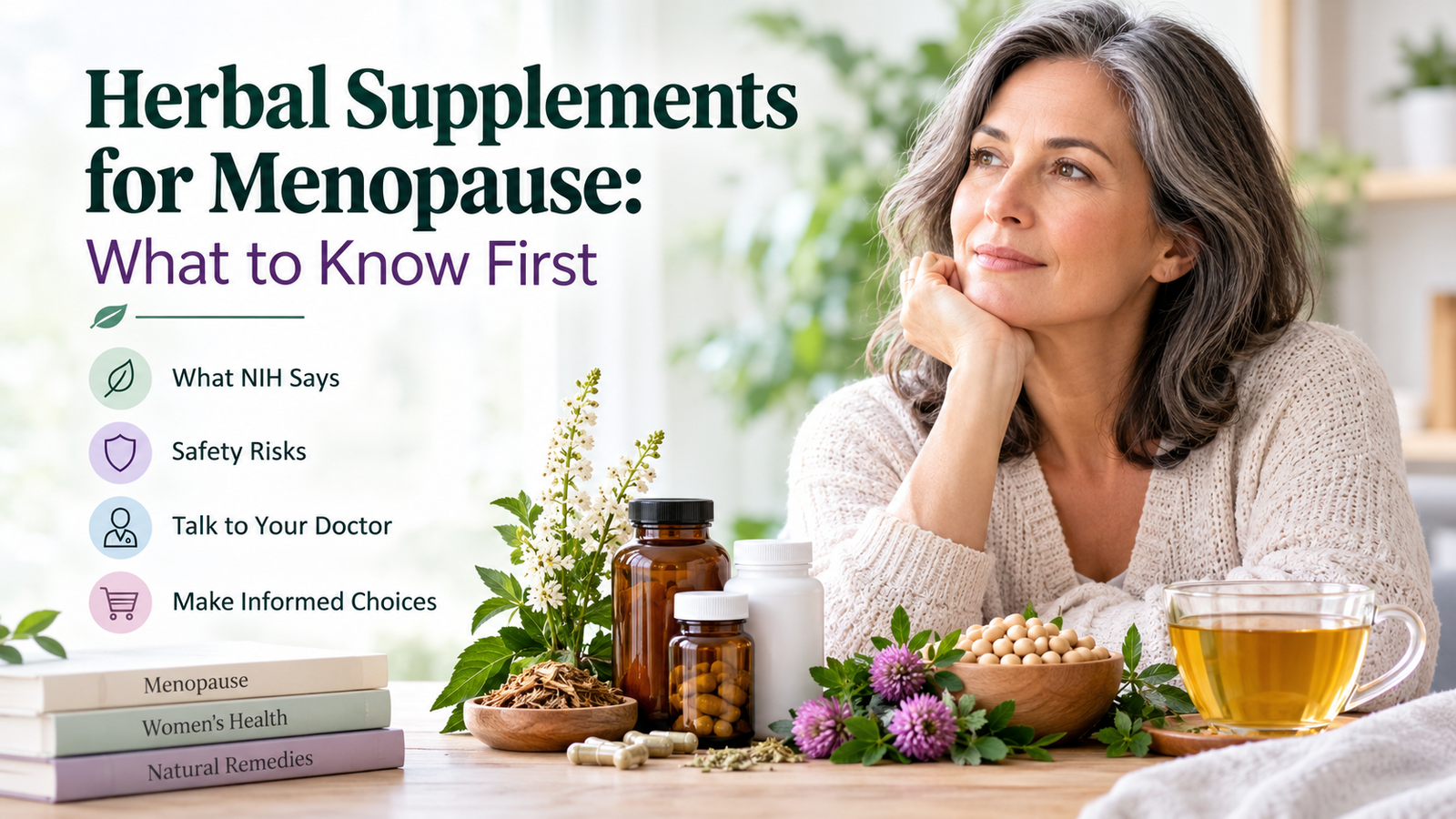
The night is unbearably hot, and your restless mind has kept you awake for what seems eternity. You take out your phone, type in a few keywords, and immediately you have a long list of menopause herbs in front of you.
Before you click “buy,” read the label. I’m only going to lean on what official health sources say, and I’ll say so when I do. There are no doses here, no brand names, and no promises. When something is just my opinion, I’ll tell you that too.
Why so many people look at herbal supplements for menopause
Menopause refers to the cessation of menstruation permanently. This is a natural process. But menopause also brings hot flashes, night sweats, sleeplessness, and extreme irritability. That’s five things to have to deal with at once. Therefore, when a product made from plants claims to help with it, people have no choice but to listen.
The trouble is that “natural” sounds safe and proven, and it isn’t automatically either one. A plant can be popular for hundreds of years and still have little solid research behind it.
What NIH says about herbal supplements for menopause
The National Center for Complementary and Alternative Medicine (NCCIH) is a part of the National Institutes of Health. According to its publication addressing menopausal symptoms, it indicates that no herb or supplement studied has been shown to be useful.
The article cites several studies looking at soy and red clover, which were reported to yield inconsistent results. Also, studies of flaxseed indicate that it is no better than placebo in relieving hot flashes.
There is little evidence to support the use of black cohosh, and a review published in 2012 concluded that there was not enough evidence to recommend it for any use. Finally, not much information is available on dong quai, evening primrose, ginseng, kava, and wild yam.Now, a fair warning. That page shows May 2017 as its last update, so newer studies may be out there. One of them comes up next.
A newer look at black cohosh and herbal supplements for menopause
Black cohosh belongs to the buttercup family and grows in North America. The root is what ends up in products.
NCCIH also has a black cohosh page, updated in November 2024. It describes a 2023 review of 22 studies that “found that they were potentially beneficial for overall menopause symptoms.” Hot flashes got better in that review, but anxiety and low mood didn’t.
One page says the proof is thin. A newer one sounds a bit warmer. That’s a mixed picture, so ask your own doctor before you try anything.
The safety side of herbal supplements for menopause
This is the part I’d read twice.
The black cohosh page says it may harm the liver in some people. It adds that these cases are rare. Nobody knows if black cohosh was really to blame. The older page also mentions rare liver damage, some of it serious. If you notice dark urine or feel unusually tired, call a health care provider.
Kava is a bigger worry. The older page links kava supplements to a risk of severe liver disease.Some plants also act a little like estrogen, and the page says they may not be safe for women who shouldn’t take estrogen. The safety of black cohosh is uncertain for women who suffer from hormone-sensitive conditions such as breast cancer or uterine cancer. The NCCIH also states that black cohosh is not safe during pregnancy or while nursing.
Next, there are drug interactions. According to the NCCIH, dong quai can interact with blood thinners, such as warfarin, and taking excessive amounts of vitamin E can increase the chances of getting a bleeding disorder.
Last, quality. A word like “standardized” doesn’t guarantee a product is consistent, NCCIH says, so two bottles with the same name can differ. Our CBD oil guide makes a similar point about reading labels. The page puts it in a few words: “natural” doesn’t always mean “safe.”
Talking with your doctor about herbal supplements for menopause
Physicians are busy, and hence the short list is important. This section includes tips from me as opposed to NCCIH guidelines. List all your symptoms, as well as the frequency in which they occur. Write down every medication, supplement, tea and other medications that you use, since even those that may seem normal can turn out to be very important. Next, find out what works for you, warning signs and when to quit.
NCCIH agrees with this by recommending that you inform all your health care providers of any complementary method you practice.
Questions to ask before you buy herbal supplements for menopause
If you happen to be standing in a shopping aisle, ask yourself these questions. What does the label say about the product inside? Has any research been done, and on people similar to myself?Could this clash with my medicine? Can I reach the company that made it? And am I buying only because the claim sounds amazing?
A label that promises a cure is a red flag. Real medicine rarely talks like that, and a bottle on a shelf shouldn’t either.
Other things people ask about
Supplements aren’t the only road. Many people talk with their doctor about sleep habits, a cooler bedroom, lighter layers, and ways to ease stress. Doctors may bring up other treatments too. I won’t give advice on those here, since the right pick depends on your health.
Easy mistakes with herbal supplements for menopause
The big one is assuming “natural” means safe. NCCIH says it doesn’t. A third would be the stacking of various products, making it hard to know what is causing the problems. In addition, some avoid visiting their doctor even though there could be an interaction between the supplement and medication. Further, others believe a claim made boldly on the bottle despite inconclusive evidence.
Your next step
Today, make a note of your three most important symptoms and all that you use. Then schedule an appointment with your physician or a menopause expert to go through this list.
In case you need more straightforward guidelines, check our posts about herbal supplements. Wise decisions regarding herbal supplements for menopause begin with information and an expert consultation.
FAQ
Do herbal supplements for menopause work?
The NCCIH reports that there is no definitive proof about the effectiveness of black cohosh for the treatment of patients; however, a study published in 2023 found that black cohosh can help ameliorate the symptoms of the condition. Always check with your physician before taking any medication.
Is black cohosh safe?
There have been some rare instances of liver complications as a result of black cohosh, however the cause for these difficulties has not been established. People suffering from hormone-sensitive conditions must be particularly vigilant. Please talk to your doctor before taking black cohosh.
Are they safe to take along with my medications?
That is not always the case. Some herbs may interact with your medications, for instance dong quai may interact with warfarin. Inform your doctor and pharmacist about everything you take including tea and vitamins.