
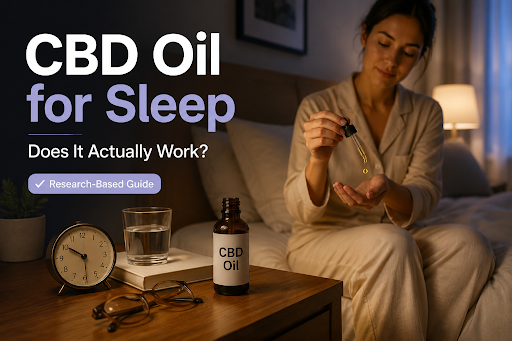
It’s 1 a.m. You’ve counted sheep. Your phone’s across the room like some sleep article told you to do. Still staring at the ceiling.So you grab the phone anyway. Type “CBD oil for sleep” into Google. Hoping for a quick fix, or at least something that isn’t another sleep article telling you to put your phone across the room.
What CBD Oil Actually Does for Sleep
CBD comes from hemp. Short for cannabidiol. It won’t get you high that’s THC’s department, and legal CBD oil keeps THC under 0.3%.
What it seems to do is take the edge off, so falling asleep stops feeling like a fight. Not a sleeping pill. More like turning down the volume on a brain that won’t shut up. Melatonin and prescription sleep meds knock you out. CBD works on the anxiety and tension that kept you wired in the first place at least that’s the theory, and it lines up with what a lot of people report.
Full Spectrum CBD Oil Benefits vs. Isolate
Every CBD label has the same three words on it: full spectrum, broad spectrum, isolate. Nobody explains what they mean.
Full-spectrum keeps the rest of the plant along for the ride trace THC, terpenes, other cannabinoids. People often say it works better for sleep than the stripped-down stuff. Could be the “entourage effect” everyone talks about, could just be that they expect it to work better. Hard to say from the outside. Broad spectrum has the same mix, minus the THC. Isolate is just CBD, nothing else.
If sleep is your main goal, full spectrum is usually the better place to start. The exception is if you need a THC-free product, say for a drug test. Either way, check the certificate of analysis before you buy. This is the only way one can be certain about what’s inside.
CBD Oil Dosage Guide: How Much Should You Take?
No consensus here, truth be told. Studies of CBD’s effect on sleep have used doses from all over the place, ranging from 25 to 75 mg per day to 150 to 300 mg at night. One tiny study simply took a group and gave them 160 mg of CBD; the sleep lasted longer that night. Just one dose.
Start small if you’re new to this. 15 to 25 mg, give it a week or two, see how you feel, then move the number if you need to. Going straight for a high dose won’t make you fall asleep faster — it just ups the odds you’re dragging the next morning. And actually read the label on your bottle, because “one dropper” doesn’t mean the same thing across brands. Could be 5 mg, could be 25.
When to Take CBD Oil for Sleep and Relaxation
Timing : Almost as important as the dose. It is taken between 30 and 60 minutes prior to sleep to ensure that it acts when you are winding up for sleep. Need the effects of relaxing during the day rather than sleeping?The studies with the best results had people taking it every day for weeks, not once and done. So if you try it one night and feel nothing, that’s not a verdict on whether it works for you. Give it more time first.
What the Research Actually Says
We won’t oversell this. The research is honestly still mixed. A 2020 review from the National Center for Complementary and Integrative Health looked at 12 studies with about 250 people. It found the evidence for CBD helping sleep was still weak. Most of the studies were small or had other problems. You can read that review on the NCCIH website if you want the full details.
Newer studies look more promising, though. A 2025 study in the Journal of Clinical Sleep Medicine tested a 300 mg CBD and terpene mix in people with insomnia. It found real improvements in deep sleep and REM sleep, not just people saying they felt better. Another study, with almost 1,800 people, found that a small 15 mg daily dose safely improved sleep over time. It didn’t beat a low dose of melatonin, though.
So what’s the honest answer? CBD oil isn’t magic. Anyone who says it is hasn’t read the research closely. But there’s enough real evidence to make it worth trying, especially if worry or a busy mind is what’s keeping you up.
Possible Side Effects and Who Should Be Careful
It should be noted that CBD is generally well-tolerated. However, this does not mean that there are no possible risks involved. This includes drowsiness and dry mouth, lack of appetite and nausea.. Some report loss of appetite and nausea. In extreme cases, CBD can lead to an alteration of liver enzymes. Moreover, it should be mentioned that CBD can affect several drugs, mainly blood thinners.
How to Choose a Quality CBD Oil
Not all CBD oil is made the same way. The sleep aisle is full of products with a lot of hype and not much testing behind them. Before you buy, look for a few things. A certificate of analysis from an outside lab, not just the company that made it. Clear labeling of milligrams per serving, not vague words like “CBD-infused. ” Hemp that’s actually grown in the U.S., where the rules are stricter. And no secret blends that hide how much of anything is really in the bottle.
We’ve already done this work for you. Our lab-tested CBD oil picks only include products that meet every one of those standards.
The Bottom Line
CBD oil for sleep isn’t a guaranteed fix. Anyone who tells you otherwise is trying to sell you something. But between the anxiety research and the newer sleep studies, there’s a real case for giving it a try. Use a sensible dose. Take it consistently. Select a brand that you can trust. Begin small, wait for about two weeks, and take note of how your body reacts. This is much more important than any individual review, including this one.
FAQ
How much CBD should you actually take?
Nobody agrees, honestly. Sleep studies have used doses all over the map — some as low as 25 to 75 mg a day, others up around 150 to 300 mg at night. One small study just gave people a single 160 mg dose. They slept longer that night. Just one dose, which is either encouraging or a sign we don’t really understand this yet.
How much should I take?
Honestly depends which study you’re reading anywhere from 15 mg to 300 mg shows up in the research. to it? Start at 15 to 25 mg and go from there
Is CBD oil safe to take every night?
Yes, as far as there’s nothing wrong with you. There haven’t been any severe side effects reported in those who used it nightly for several weeks. However, if you are taking other medications or have some health problems, consult your doctor first.